
Tools
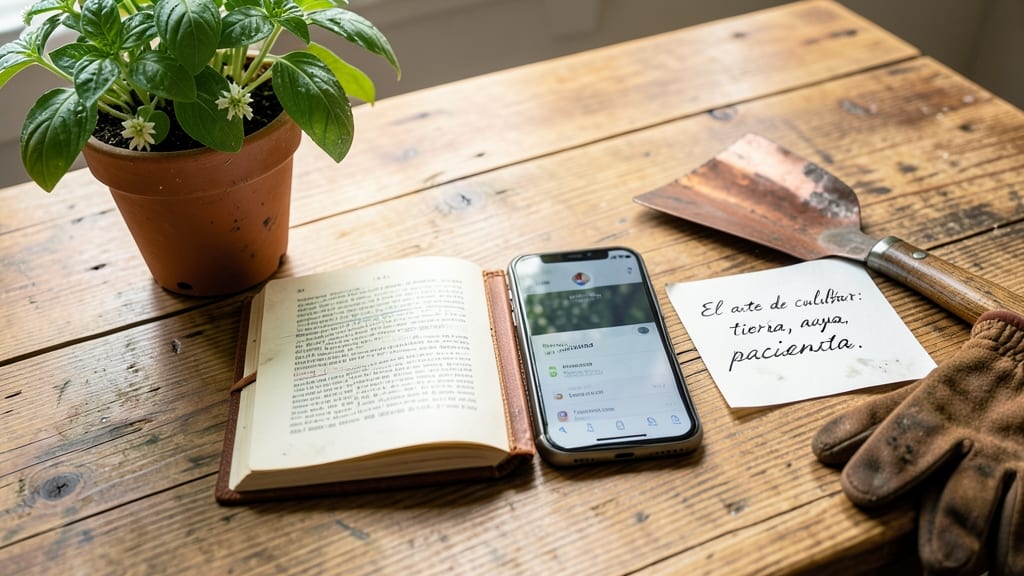
To say 'gardening' in Spanish, use jardineria for the activity or jardin for the garden space. Common phrases include cultivar plantas (to cultivate plants) or trabajar en el jardin (to work in the garden). Latin American dialects often use huertar for vegetable gardening.
Spanish has two core terms for gardening: jardineria refers to the practice itself, while jardin describes the physical space where plants grow. 🌿 For example, you might say Estoy haciendo jardineria ("I'm gardening") or Mi jardin tiene rosas ("My garden has roses").
Regional differences add flavor—huerta (common in Mexico and Central America) specifically means a vegetable patch, while jardin can also imply a decorative garden in some contexts.
Beyond the basics, Spanish speakers often use action verbs to describe gardening tasks. Podar means "to prune," regar is "to water," and abonar translates to "to fertilize." These verbs help you communicate specific activities clearly.
For instance, instead of just saying jardineria, you could say Voy a podar los arbustos ("I'm going to prune the shrubs") to be more precise.
💡 In This Article
- Jardineria vs Jardin: Key Differences in Spanish Gardening Terms
- Essential Spanish Gardening Phrases for Plant Care and Tools
Jardineria vs jardin: key differences in Spanish gardening terms
The distinction between jardineria and jardin comes down to whether you're describing the activity or the space. Jardineria (pronounced "har-dee-nee-ryah") specifically refers to the practice of gardening—like saying "I love jardineria" means "I love gardening."
Meanwhile, jardin (pronounced "har-deen") means the physical garden itself, such as "Mi jardin tiene flores" ("My garden has flowers"). This difference mirrors English's distinction between "gardening" (activity) and "garden" (space).
Spanish-speaking countries also introduce regional variations that add depth. In Mexico and Central America, huerta (pronounced "wehr-tah") refers specifically to a vegetable garden, while jardin might imply a decorative or ornamental space.
For example, a Mexican farmer might say, "Tengo una huerta con tomates" ("I have a vegetable garden with tomatoes"), whereas a Spanish gardener would say, "Mi jardin tiene rosas" ("My garden has roses"). These nuances reflect cultural differences in gardening priorities—utilitarian in Latin America versus ornamental in Spain.
Context matters when choosing the right term. If you're discussing tasks or skills, jardineria is the correct choice. For instance, "Estudio jardineria" means "I study gardening." But if you're talking about the physical location, jardin takes center stage.
Even within jardin, there are subtleties: in some regions, jardin can also mean a public park or a botanical garden, while jardin de infantes specifically refers to a kindergarten. This flexibility makes Spanish gardening vocabulary rich and adaptable.
Pronunciation can also trip up learners. The "j" in both words is pronounced like an English "h" sound, which might feel unusual for English speakers. Jardineria has four syllables: "har-dee-nee-ryah," while jardin is two: "har-deen."
Practice these with a native speaker or use apps like Forvo to hear the correct pronunciation. Mispronouncing these words can lead to confusion, especially in rural areas where gardening terms are used daily.
For example, saying "har-din-ee-ryah" instead of "har-dee-nee-ryah" might make you sound like you're describing a different activity entirely.
Understanding these terms helps you communicate more precisely. For instance, if you're describing your weekend project, you might say, "Voy a trabajar en mi jardin hoy" ("I'm going to work in my garden today"), using jardin for the space.
But if you're explaining your hobby, you'd say, "Mi pasión es la jardineria" ("My passion is gardening"), using jardineria for the activity. This precision ensures you're understood whether you're chatting with a gardener in Madrid or a farmer in Mexico City.
Here's a quick reference for clarity:
- Activity (gardening as a practice): Jardineria (e.g., "Me encanta la jardineria")
- Space (physical garden): Jardin (e.g., "Mi jardin es pequeño")
- Vegetable garden (Latin America): Huerta (e.g., "Cultivo en mi huerta")
- Public park or botanical garden: Jardin público or jardin botánico
Mastering these terms will help you navigate conversations about gardening in Spanish with confidence, whether you're discussing soil types, plant care, or garden layouts. 🌱