
Tools
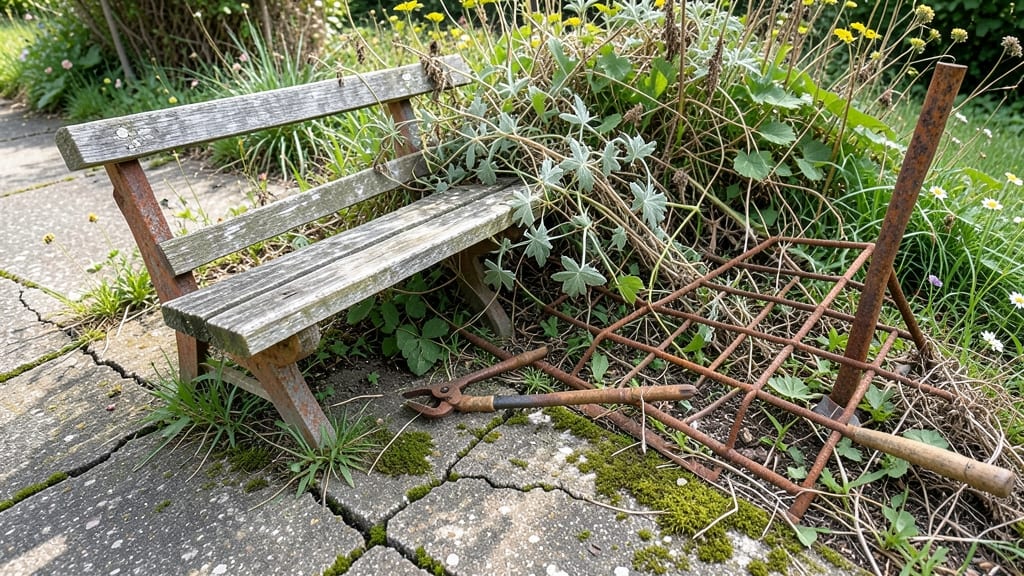
Reviving a rusted garden begins with removing rust using steel wool or white vinegar, followed by applying mineral oil or WD-40 to protect the metal. Stop future corrosion by storing tools in dry areas, using protective coatings, and drying them thoroughly after each use.
Rust forms when iron in your tools reacts with oxygen and moisture, creating that familiar reddish-brown flakes. 🔥 In garden settings, this process speeds up thanks to soil minerals and frequent exposure to damp conditions. The good news?
Most tools can be saved with the right approach—scrubbing with abrasives or acidic solutions breaks down the rust layer, while protective coatings create a barrier against future moisture damage. I’ve found that tools treated this way can last decades if stored properly, making it a worthwhile investment of time.
For stubborn rust, commercial rust removers work faster than vinegar but may require gloves and ventilation. Once cleaned, mineral oil penetrates better than WD-40 for long-term protection, though WD-40’s quick-dry formula is ideal for emergency fixes.
The key is consistency—even a light coat of oil after cleaning makes a noticeable difference in preventing future buildup.
💡 In This Article
- Science Behind Rust Formation and Tool Corrosion
- Step-by-Step Guide to Restoring and Protecting Garden Tools
Science behind rust formation and tool corrosion
Rust isn't just surface damage—it's an electrochemical reaction where iron (Fe) in your tools combines with oxygen (O₂) and water (H₂O) to form iron oxide (Fe₂O₃). This process starts with the formation of a thin layer of magnetite (Fe₃O₄), which then converts to the reddish-brown rust we recognize.
In garden conditions, this reaction accelerates because soil contains salts and minerals that act as electrolytes, speeding up electron transfer between iron atoms.
The moisture in garden soil creates the perfect environment for rust—even humidity levels above 60% can trigger corrosion. Salt from fertilizers or seawater (if near coastal areas) further damages tools by breaking down protective oxide layers.
The pH level matters too: acidic soils (pH < 7) dissolve protective coatings faster than neutral or alkaline soils. For example, a pH 5 soil can corrode tools 10 times faster than a pH 7 environment due to increased hydrogen ion activity.
What most people overlook is how rust spreads. Once started, the rust layer isn't uniform—it creates tiny cracks where more moisture seeps in, forming a self-perpetuating cycle. This is why tools left in damp conditions for weeks develop rust rings that spread inward like tree roots.
The good news? Removing rust early stops this process before it becomes irreversible.
Temperature also plays a role—tools left in direct sunlight heat up, causing thermal expansion that weakens metal bonds. Meanwhile, cold mornings with dew formation create condensation on tool surfaces, providing constant moisture.
This daily cycle of heating and cooling accelerates corrosion over time, which is why tools stored outside without protection degrade faster than those kept indoors.
Understanding these factors helps explain why some tools rust quickly while others resist. For instance, stainless steel tools contain chromium (Cr), which forms a passive oxide layer that blocks further corrosion. Regular carbon steel tools lack this protection, making them more vulnerable to garden conditions. 🔥