
Tools
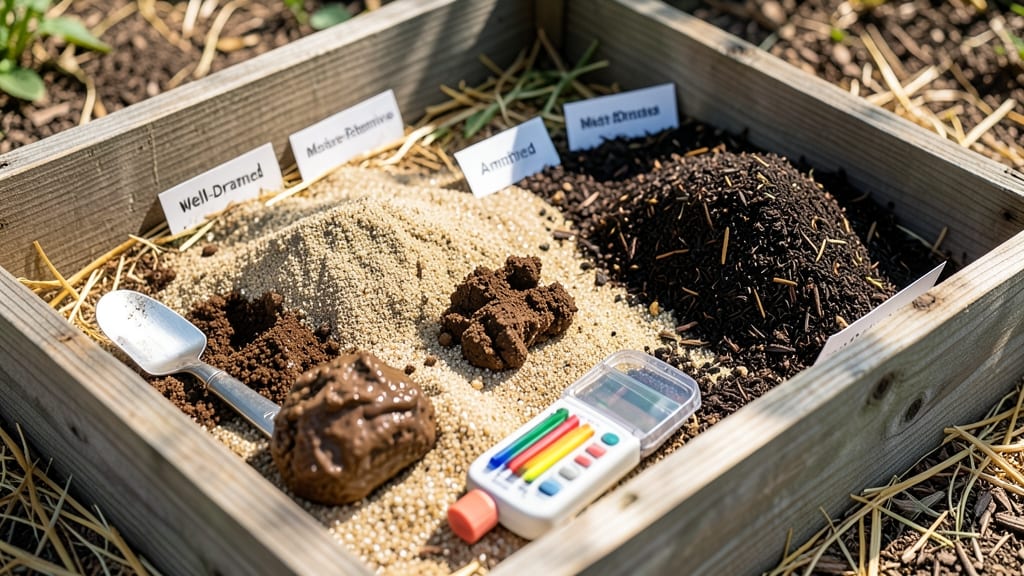
For garden beds, the best soil to use is well-draining loam—a balanced mix of sand, silt, and clay that retains moisture while allowing roots to thrive. Adjust texture by amending heavy clay with compost or mixing sand into dense soils for optimal plant growth.
What soil to use for garden beds is loam, your secret weapon for thriving plants because it strikes the perfect balance between drainage and moisture retention. 🌱 Unlike pure sand—which drains too quickly—or heavy clay—which holds water and suffocates roots, loam's crumbly texture provides the ideal environment for root systems to spread and access nutrients. For heavy clay soils, I recommend mixing in 3-4 inches of compost and 1 part perlite to every 3 parts soil, while sandy soils benefit from adding 2 parts peat moss or coconut coir to 1 part sandy soil. This creates a foundation that supports everything from leafy greens to root vegetables.
What makes loam truly special is its natural ability to support beneficial microbial life, which breaks down organic matter into plant-available nutrients. When working with existing soil, conduct a simple jar test: fill a jar with soil and water, then shake and observe how quickly the layers separate.
A well-balanced loam will show distinct but evenly distributed layers of sand, silt, and clay after settling. This quick test helps you understand what amendments your garden might need before planting.
💡 In This Article
- How Loam, Sand, and Clay Affect Plant Growth
- DIY Soil Mixes for Different Garden Bed Needs
How loam, sand, and clay affect plant growth
The magic of loam lies in its perfect trifecta of sand, silt, and clay particles (about 40% each) that create tiny air pockets while holding moisture and nutrients. Sand provides drainage and prevents compaction, while clay retains water and nutrients, and silt acts as the glue that binds them together.
This structure allows roots to breathe while accessing water and minerals efficiently—critical for plants like tomatoes that need consistent moisture but hate soggy roots. 🌱 The ideal loam has a 5-10% porosity rate, meaning 10-20% of its volume is air, which is essential for microbial activity that breaks down organic matter into plant food.
Clay soils, on the other hand, pack tightly when wet and become rock-hard when dry, creating anaerobic zones that suffocate roots. Their tiny particles hold water like a sponge but block oxygen flow, often leading to root rot in plants like peppers.
The solution? Adding 2-3 inches of compost and 1 part gypsum per 10 square feet helps break up clay's dense structure over time. Sandy soils drain too quickly, flushing away nutrients and leaving plants thirsty—like a desert for your basil.
Mixing in 2 parts peat moss or coconut coir per 1 part sand improves water retention while maintaining aeration.
pH plays a hidden role too—most vegetables thrive in slightly acidic to neutral soil (6.0-7.0), while blueberries need acidic (4.5-5.5) soil. Loam naturally buffers pH swings better than pure sand or clay.
The microbial ecosystem in loam also converts organic matter into plant-available nitrogen, phosphorus, and potassium through a process called mineralization. Without this biological activity, even the best fertilizer won't perform optimally. 🔬 For example, compost tea applied to loam can increase microbial populations by 30-50% compared to bare soil.
Let's talk aeration—the unsung hero of root health. Clay soils can have 5-15% air space when dry, dropping to nearly 0% when saturated, while sandy soils maintain 25-35% air space but lose water too fast.
Loam's structure keeps air space consistent at 15-25%, perfect for root respiration. This is why raised beds filled with loam-based mixes often outperform in-ground planting—roots don't compete for space or nutrients with surrounding soil.
Consider this visual: Imagine roots as straws sipping water. In clay, they struggle through thick syrup; in sand, they sip from a leaky cup. Loam offers the smoothest, most consistent flow. For container gardens, this becomes even more critical since plants have limited root space.
A mix of 60% loam, 20% compost, and 20% perlite creates the ideal container soil that drains well while holding enough moisture for herbs like thyme or parsley.
The best part? You can transform your soil's texture with simple amendments. For every 100 square feet of heavy clay, add 2-3 cubic yards of compost and 10 pounds of perlite. For sandy soil, blend 1 part peat moss with 2 parts sand and 1 part vermiculite.
These ratios create the loam-like structure plants crave, whether you're growing vegetables or flowers. The key is patience—soil improvement is a long-term investment that pays off with stronger, healthier plants year after year.