
Tools
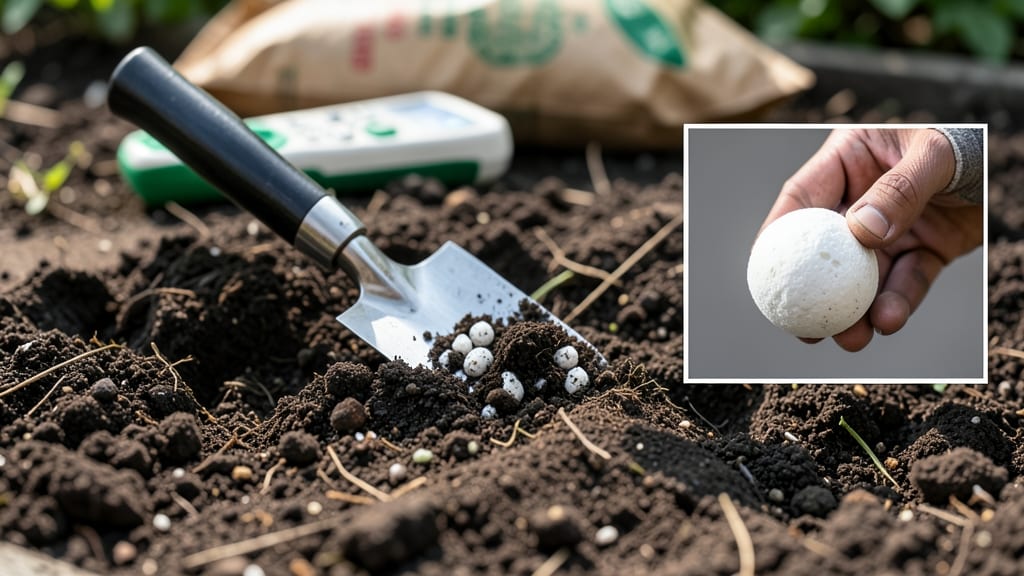
When you spot white balls in garden soil, they're usually harmless gypsum chunks, undissolved fertilizer, or pest eggs that can damage roots. Test them by crushing—gypsum crumbles, fertilizer dissolves, and pest eggs require immediate treatment with vinegar or organic sprays.
These mysterious white specks often appear after heavy watering or fertilizer application, signaling either mineral buildup or pest activity. 🔥 Gypsum forms when calcium sulfate crystallizes, while fertilizer granules can remain intact if not fully dissolved.
The real concern is pest eggs—especially from fungus gnats—which hatch into larvae that feed on roots. I recommend checking plant health first: yellowing leaves or stunted growth often point to root damage from eggs or excess salts.
For removal, start by gently sifting the top 2 inches of soil to locate the balls. Gypsum can be safely crushed and worked into the soil, while fertilizer should be flushed with water.
If you suspect pest eggs, mix equal parts water and white vinegar in a spray bottle and apply directly to the affected area. Always wear gloves—some pest eggs may carry pathogens.
💡 In This Article
- Identifying Common Causes of White Balls in Soil
- Safe Removal Methods for Different Types of White Balls
Identifying common causes of white balls in soil
Gypsum deposits form when calcium sulfate crystallizes in alkaline soils, creating those chalky white balls that crumble easily between your fingers. This mineral buildup often appears after heavy watering or in areas with high evaporation rates.
The texture is distinctly gritty yet soft, almost like crushed seashells, and it won't dissolve in water. You'll typically find these deeper in the soil profile—around 3-6 inches down—where moisture levels fluctuate most dramatically.
Undissolved fertilizer granules present a different challenge—they maintain their original shape and often have a slightly rough, plastic-like texture. These usually appear near the soil surface where you applied them, often in clusters around plant bases. The key difference?
Fertilizer granules will dissolve slowly in water (especially water-soluble types like urea or ammonium nitrate), leaving behind a faint chemical aroma. If your soil tests show high salt levels or plants exhibit leaf burn despite regular watering, fertilizer buildup is likely the culprit.
Pest eggs represent the most concerning case, particularly from fungus gnats or shore flies, whose larvae can devastate root systems. These eggs appear as tiny, translucent white spheres—often 0.5mm in diameter—clustered on soil surfaces or within the top 1 inch of substrate.
The real giveaway is plant symptoms: sudden wilting, root rot, or a visible population of tiny black larvae in moist soil. Unlike gypsum or fertilizer, these eggs won't dissolve—they're designed to withstand environmental conditions until hatching.
Mineral deposits from hard water (calcium carbonate) can also create white balls, though they're usually harder and more irregular in shape. These form when water evaporates, leaving behind mineral crusts that resemble tiny stalactites.
The location matters here too—hard water deposits often appear on container edges or in raised beds where water pools and evaporates repeatedly. To test, try dissolving a sample in vinegar: if it fizzes vigorously, you're dealing with calcium carbonate rather than gypsum.
Seasonal patterns help distinguish causes too. Gypsum buildup peaks in dry seasons when evaporation outpaces watering, while fertilizer granules become visible after application. Pest eggs, however, show no seasonal preference—they're always a risk in moist, organic-rich soils.
Pay attention to when you first notice these balls: recent watering suggests gypsum, recent fertilization points to granules, and consistent moisture with declining plant health likely means pest activity.
Here's a quick visual guide to help identify them:
- Gypsum: Soft, crumbly, found 3-6 inches deep, no smell
- Fertilizer: Plastic-like texture, dissolves in water, often clustered near surface
- Pest eggs: Tiny (0.5mm), translucent, accompanied by plant stress
- Mineral deposits: Hard, irregular, fizzes in vinegar, found near water evaporation zones