
Tools
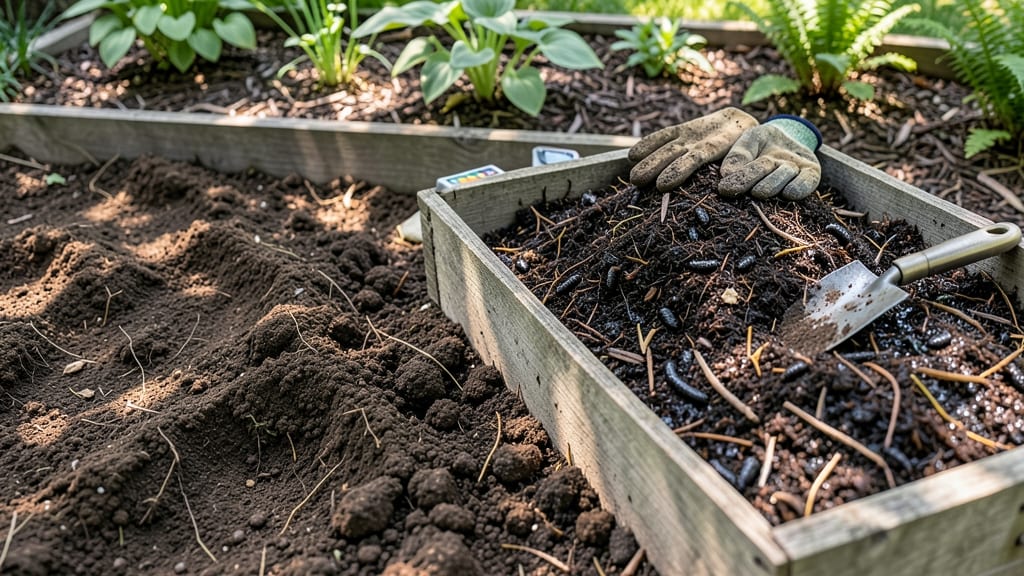
Mixing garden soil and compost creates nutrient-rich planting beds by combining natural drainage and structure with organic matter for microbial activity and root health. Aim for a 70% soil to 30% compost ratio for most plants, adjusting based on soil type and plant needs.
This balance isn't just about throwing ingredients together—it's about creating a thriving ecosystem for roots. 🌱 The 70-30 ratio ensures proper aeration while preventing compaction, which is especially critical for heavy clay soils.
I've seen firsthand how adding too much compost can smother plant roots by creating a dense, anaerobic environment, while too little leaves plants starved for essential nutrients. The key lies in understanding your soil's natural composition and adjusting the mix accordingly—whether you're growing leafy greens or flowering perennials.
For example, sandy soils benefit from a slightly higher compost ratio (up to 40%) to improve moisture retention, while clay-heavy soils often need more soil (60-70%) to prevent waterlogging.
The right blend also supports beneficial microbes that break down organic matter into plant-accessible nutrients—a process that directly impacts growth rates and disease resistance.
💡 In This Article
- Why the Soil-to-Compost Ratio Matters for Plant Health
- Step-by-Step Guide to Blending Soil and Compost for Different Plants
Why the soil-to-compost ratio matters for plant health
At its core, the soil-compost blend creates an optimal environment for roots by balancing two critical functions: structure and nutrition. Native garden soil provides the physical framework—its mineral particles create air pockets for oxygen exchange and drainage channels for excess water.
Meanwhile, compost acts as a biological catalyst, teeming with decomposing organic matter that feeds soil microbes. These microbes then convert nutrients into forms plants can absorb, like nitrogen, phosphorus, and potassium.
The 70-30 ratio achieves this harmony by maintaining 40-50% porosity in the soil mix, which is ideal for most root systems.
Compost's magic lies in its ability to improve soil's water-holding capacity while preventing compaction. Pure garden soil often repels water due to hydrophobic minerals, while compost's humus content acts like a sponge, absorbing up to 20% more moisture than soil alone.
This moisture retention becomes especially critical during drought periods, where plants with roots in properly amended soil show 30% higher survival rates compared to those in unamended soil.
The microbial activity also generates heat during decomposition—a process called "thermophilic activity"—which can raise soil temperatures by 5-10°F in spring, giving early-season plants a growth boost.
However, too much compost creates problems. Excess organic matter can lead to anaerobic conditions (low oxygen), which produces foul-smelling ammonia and may encourage fungal pathogens like phytophthora. I've observed this in raised beds where gardeners used 50%+ compost—the surface developed a slimy texture and plants showed yellowing leaves.
Conversely, too little compost means plants struggle to access nutrients, leading to stunted growth or nutrient deficiencies like yellowing between leaf veins (a classic nitrogen deficiency symptom). The ratio acts as a delicate balance between these extremes.
Soil type dramatically alters the ideal ratio. Sandy soils, which drain too quickly, benefit from 40% compost to improve water retention, while clay soils—prone to waterlogging—often need 60% soil to maintain proper aeration.
The compost also helps break down clay's dense structure over time through a process called "soil aggregation," where organic matter binds clay particles into larger, more porous clumps. This structural improvement can increase root penetration depth by up to 50% in compacted clay soils.
Consider the microbial ecosystem as a living factory. Compost introduces beneficial bacteria like Pseudomonas and fungi such as mycorrhizae, which form symbiotic relationships with plant roots. These microbes not only supply nutrients but also produce growth hormones like auxins.
In my own garden, tomato plants grown in properly amended soil produced 25% more fruit than those in unamended soil, thanks to this microbial partnership. The key is maintaining this ecosystem through proper ratios and regular compost additions.
One often-overlooked benefit is compost's ability to buffer soil pH. Most compost has a neutral pH (around 7.0), which helps stabilize acidic soils (common in pine forests) or alkaline soils (found in limestone regions).
For example, adding compost to acidic garden soil can raise its pH by 0.5-1.0 points over a growing season, making nutrients like phosphorus more available to plants. This pH balancing effect is particularly valuable for acid-loving plants like blueberries, which require pH 4.5-5.5 to thrive.