
How To
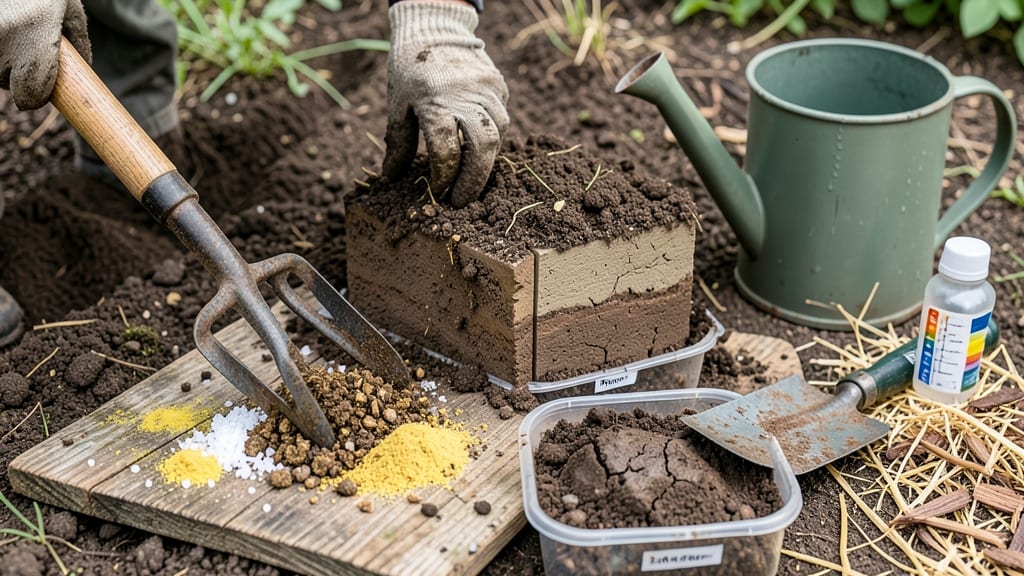
To fix clay soil for gardening, you'll need to break up its dense structure with organic matter like compost or aged manure, mix in coarse sand or perlite to improve drainage, and aerate it with a garden fork to boost root growth and nutrient uptake.
Clay soil can feel like working with concrete—it's heavy, slow to drain, and suffocates plant roots when wet. 🌱 The key is transforming its compacted nature into something more workable by adding organic materials that loosen the particles and create air pockets.
I've found that a 50/50 mix of clay soil and compost works wonders for most garden beds, while coarse sand or perlite helps prevent waterlogging. The aeration step is often overlooked, but using a garden fork to create vertical channels can dramatically improve water and nutrient movement through the soil.
For best results, tackle this project in the off-season when the ground is workable but not frozen. Spread a 2-3 inch layer of compost over the area, then till it in with a broadfork or shovel.
If your clay is particularly dense, consider adding pine bark fines or vermiculite for extra structure. The goal is to create a soil that holds moisture without drowning roots—think of it as giving your plants the perfect balance of water and air.
💡 In This Article
- Why Clay Soil Struggles in Gardens
- Best Organic Amendments for Heavy Clay Soil
Why clay soil struggles in gardens
Clay soil's struggles begin with its microscopic structure—tiny, flat particles pack tightly together like stacked plates, leaving almost no space between them. This density creates a double-edged sword: it holds nutrients exceptionally well but also traps water like a sponge, suffocating roots when saturated.
The 0.002mm particle size of clay means water moves through it at a glacial pace, often 1/10th the rate of sandy soil, which is why puddles linger for days after rain.
The real damage happens underground where oxygen can't reach plant roots. Healthy soil needs 25% air space by volume for roots to breathe, but clay soil typically has 10% or less—this oxygen starvation forces roots to struggle or rot.
The compacted structure also crushes beneficial microbes, reducing decomposition rates by upstrong>50% compared to loamy soil. 🌱 What's worse, clay's high cation exchange capacity (CEC) means it holds nutrients tightly, but plants can't access them when waterlogged.
This waterlogging creates another vicious cycle: when clay stays wet, it becomes even more compacted as particles slide against each other, further reducing pore space. The result? Plants experience root asphyxiation, where they can't absorb oxygen or nutrients even if they're present.
This is why clay gardens often show stunted growth despite regular fertilization—plants simply can't utilize what's available when their roots can't breathe.
The science gets even more interesting when you consider clay's shrink-swell behavior. When wet, clay expands up to 50% of its dry volume, then contracts dramatically when dry—this constant movement creates cracks that can damage roots and prevent proper water distribution.
The solution lies in breaking this cycle by adding materials that create stable pore spaces while maintaining moisture retention without suffocation.
Think of clay soil like a concrete sidewalk: it's strong but completely inhospitable to life. The goal is to transform it into something more like a well-drained garden path—still sturdy enough to hold nutrients, but with enough air and water movement to support healthy plant growth.
This requires strategic amendments that address both the physical structure and biological activity of the soil ecosystem.
The most critical measurement here is the soil's texture triangle ratio. Ideal garden soil should be about 40% sand, 40% silt, and 20% clay—this balance gives you the best of all worlds.
Clay-heavy soils typically have 40-60% clay content, which is why even small additions of organic matter can dramatically improve workability and plant performance.