
Companion Plants
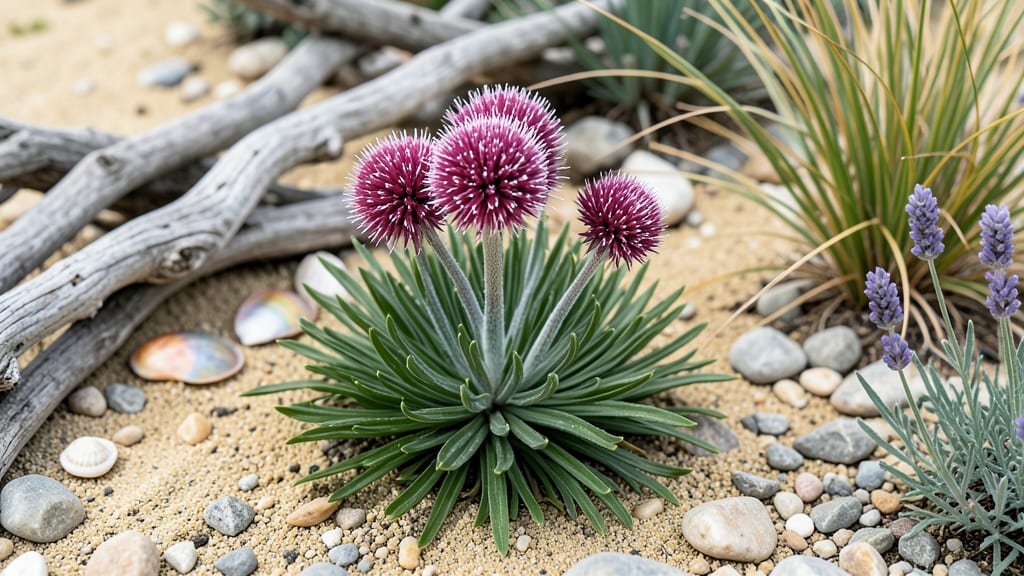
For seaside gardens, salt-tolerant plants like sea oats, beach roses, and sea lavender thrive because they resist wind damage and salty soil while needing little freshwatering. Drought-resistant succulents like sedum also perform exceptionally well in coastal environments.
Coastal plant life has evolved to handle the harshest conditions—salty air, sandy soil, and relentless winds. 🌊 The key is selecting species that naturally exclude salt through their roots while maintaining flexibility to sway without breaking.
I've found that grasses like sea oats act as natural windbreaks, protecting smaller plants behind them, while beach roses provide vibrant color that stands out against the muted tones of shoreline landscapes. These plants aren't just survivors—they're the backbone of resilient coastal ecosystems.
What makes this selection particularly practical is their minimal care requirements. Most thrive on natural rainfall and sandy soil, eliminating the need for frequent watering or soil amendments. Sedum varieties, for example, store water in their leaves, making them ideal for areas where freshwater is scarce.
The trade-off? You'll need to monitor for invasive species that might outcompete your chosen plants, especially in dune environments where native species are already struggling.
💡 In This Article
- How Salt and Wind Affect Coastal Plant Survival
- Best Low-Maintenance Seaside Garden Plant List
How salt and wind affect coastal plant survival
Coastal plants have evolved remarkable physiological adaptations to thrive where freshwater plants would perish. The most critical mechanism is salt exclusion, where plants like sea lavender (Limonium spp.) use specialized cells in their roots to filter out excess sodium chloride before it enters their vascular system.
These plants maintain osmotic balance by producing compounds called proline and glycine betaine, which protect cellular structures from salt-induced damage. For example, beach grasses like sea oats (Uniola paniculata) can tolerate soil salinity levels up to 1.5%—about 25 times saltier than typical garden soil—while still absorbing essential nutrients.
The wind resistance strategies of coastal plants are equally fascinating. Plants like beach heather (Erica cinerea) develop flexible, wiry stems that bend rather than snap in 70+ mph gusts, while their deep, fibrous root systems (often extending 3-5 feet deep) anchor them firmly in shifting sands.
Another adaptation is reduced leaf surface area: many coastal species have narrow, rolled leaves that minimize wind resistance. For instance, the American beachgrass (Ammophila breviligulata) has leaves that grow in dense clumps, creating microclimates that reduce wind exposure for neighboring plants by up to 40%. 🌬️
Soil salinity creates another challenge by disrupting nutrient uptake. High salt concentrations force plants to expend energy on ion exclusion rather than growth, which is why many coastal species have developed succulent storage tissues to conserve water and nutrients.
Plants like sea thrift (Armeria maritima) can actually accumulate salt in their leaves without harm, using it as a defense mechanism against herbivores.
This process, called halophytism, allows them to thrive in environments where freshwater plants would suffer from physiological drought—a condition where water becomes unavailable to roots due to high salt concentrations.
Wind also plays a dual role in coastal ecosystems. While it can damage plants, it also aerates sandy soils and distributes seeds over long distances, promoting genetic diversity.
However, the constant abrasion from salt-laden wind can wear down plant tissues, which is why many coastal species produce thick, waxy cuticles on their leaves. For example, the sea lavender's leaves have a cuticle layer 10-15 times thicker than typical garden plants, reducing water loss and protecting against salt spray.
This adaptation is crucial in areas where salt spray can deposit up to 10 grams of salt per square meter annually.
Understanding these adaptations helps explain why some plants thrive while others fail in coastal gardens. For instance, dune grasses like marram grass (Ammophila arenaria) can stabilize sand dunes by trapping windblown particles, while shrubs like beach rose (Rosa rugosa) produce hip fruits that birds disperse, ensuring the species spreads naturally.
The key takeaway? Successful coastal plants don't just tolerate harsh conditions—they leverage them to their advantage. 🌊