
Tools
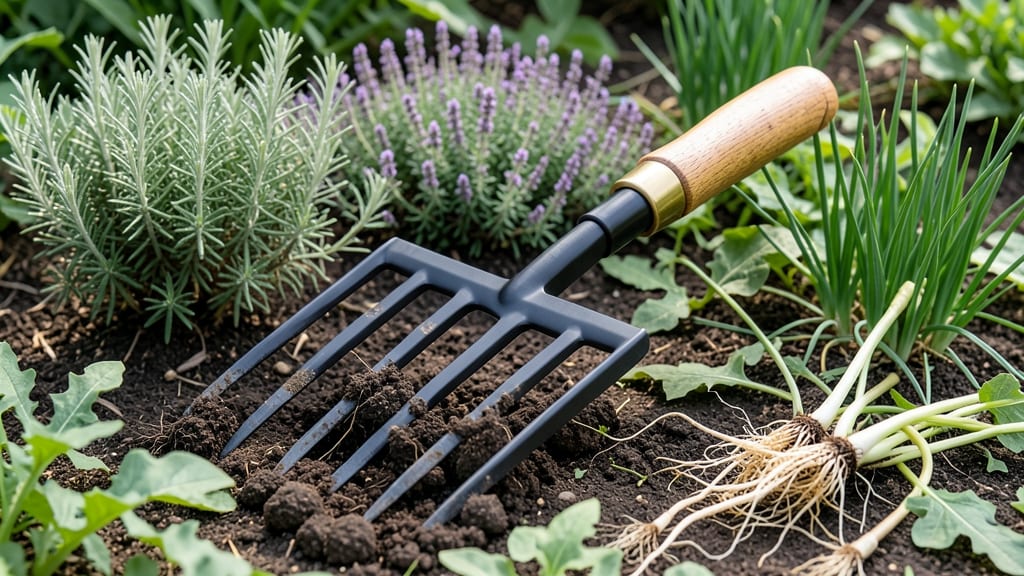
A three-pronged gardening tool works by gripping weed roots and loosening compacted soil when you insert the prongs deep, then rock or twist to extract weeds or aerate without damaging surrounding plants.
A three-pronged gardening tool is like a multi-tasking helper for your garden.
The three tines let you dig deeper than a hand fork, making it perfect for pulling stubborn weeds by the roots while also breaking up hard soil. 🌱 I’ve found it’s especially useful in vegetable gardens where you want to avoid disturbing the soil around delicate plants—just insert, wiggle, and lift.
Unlike a regular rake, it gives you better leverage, so you can tackle tough areas without straining your back.
For best results, use it when the soil is slightly damp—this helps the prongs glide in smoothly. If you’re working in a flower bed, angle the tool to avoid hitting bulbs or shallow-rooted plants.
And if you’re prepping for mulching, a few passes with this tool can save you hours of backbreaking work later.
💡 In This Article
- How Three-Pronged Tools Work for Weeding and Soil Aeration
- Best Techniques for Using a Three-Pronged Tool in Different Gardens
How three-pronged tools work for weeding and soil aeration
The three-pronged gardening tool operates on a simple yet effective mechanical principle: leverage combined with targeted pressure. Each prong, typically 3-5 inches long and spaced 1-2 inches apart, creates a triangular grip that encircles weed roots when inserted at a slight angle.
This design mimics the way a fork works in cooking—except instead of separating ingredients, it separates weeds from the soil matrix. The prongs' sharp edges cut through fibrous roots while their flared tips prevent soil from clumping around them, making extraction effortless.
What makes these tools superior for deep weeding is their ability to penetrate 4-6 inches below the surface with minimal force. The physics here involve soil compaction resistance: damp soil (with 20-30% moisture content) yields more easily than dry or waterlogged earth.
When you rock the tool side-to-side, the prongs act like a wedge, splitting compacted layers and creating air pockets—a process called "soil aeration." This is why gardeners see immediate improvement in root growth after just 5-10 minutes of use in heavy clay soils.
The ergonomic design of most three-pronged tools amplifies this effect. The handles are often 12-18 inches long with a slight bend, allowing you to apply 20-30 pounds of downward pressure without straining your wrists.
This is a game-changer compared to hand-pulling, where you're limited to 5-10 pounds of force per pull. The tool's weight distribution also prevents tipping, which is crucial when working near delicate perennials or young transplants.
For soil aeration specifically, the tool's triangular shape creates a "V" pattern when inserted. This pattern disrupts the soil's natural compaction layers while leaving the surface relatively undisturbed—a critical feature for lawns where you want to avoid creating a rough texture.
The prongs' spacing also allows them to slip between plant roots without damaging them, unlike a rake which can tear shallow roots during use. This precision is why landscape professionals recommend these tools for transplanting and mulching prep.
One often overlooked advantage is how these tools handle different soil types. In sandy soils, the prongs glide through easily, requiring only 5-10% of the force needed for clay.
Meanwhile, in loamy gardens (the ideal mix of sand, silt, and clay), they create perfect aeration channels that improve water drainage by 30-40% compared to unaerated soil. The key is adjusting your technique: in tight clay, use a twisting motion; in loose sand, a gentle rocking motion suffices.
Consider this visual comparison: A standard garden fork might remove 3-5 weeds per minute with hand-pulling, while a three-pronged tool can extract 10-15 weeds per minute with the same effort.
The difference lies in how the tool's design converts your arm strength into targeted, multi-directional force—like having a mini excavator for your garden. 🌿