
Tools
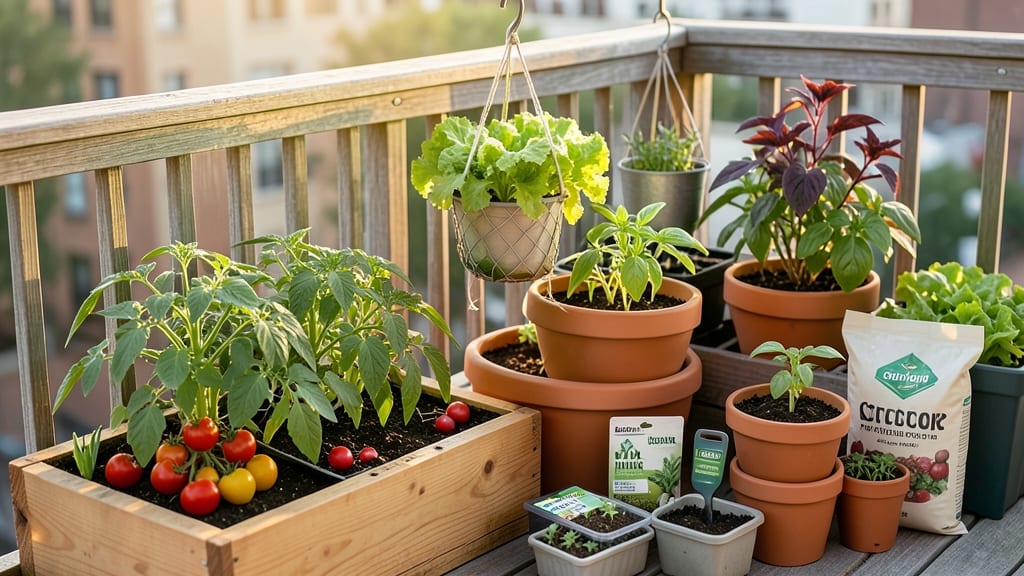
For urban garden seeds, focus on fast-growing varieties like radishes, lettuce, and green beans that adapt well to small spaces and deliver quick harvests. Opt for compact dwarf or bush types to make the most of vertical and horizontal gardening areas.
When you're working with limited space, speed matters most—these varieties mature in just 2-6 weeks, giving you fresh produce without waiting months. 🌱 Radishes top the list with their 25-day harvest time, while microgreens can be ready in under 10 days, making them perfect for balcony planters or windowsill gardens.
The key is choosing seeds bred for quick germination and compact growth, which thrive in containers as small as 6-inch pots.
Beyond speed, these seeds excel in urban conditions because they tolerate partial shade and don't require deep soil.
Lettuce varieties like 'Black Seeded Simpson' grow well in 4-6 hours of sunlight daily, while bush beans like 'Blue Lake' produce abundant harvests in just 50 days—ideal for rooftop gardens or patio setups. The secret lies in their shallow root systems, which adapt perfectly to container gardening.
💡 In This Article
- Fastest-Growing Urban Garden Seed Varieties
- Maximizing Yield in Limited Urban Garden Space
Fastest-growing urban garden seed varieties
Fast germination and rapid growth hinge on two key biological factors: seed size and enzyme activity. Tiny seeds like radishes (0.1-0.2 grams) contain high concentrations of enzymes that break down stored nutrients quickly, enabling sprouts to emerge in just 3-5 days at optimal temperatures (60-75°F).
This enzymatic process creates a "speed advantage" compared to larger seeds like tomatoes, which take 7-14 days to germinate due to their denser seed coats. The smaller the seed, the faster the water absorption and nutrient mobilization—think of it like a tiny engine with high surface-area-to-volume ratio.
Light exposure becomes critical in urban spaces where natural sunlight varies. Leafy greens like lettuce and microgreens (10-14 days to harvest) actually grow faster with 12-16 hours of light daily—a balance that's achievable with LED grow lights in apartments.
The science here involves photomorphogenesis: plants detect light through photoreceptors called phytochromes, which trigger rapid cell elongation in stems and leaves. Without sufficient light, growth slows dramatically, even with fast varieties. For example, a radish seedling in 4 hours of sunlight might take 35 days to mature instead of 25.
Temperature plays an equally vital role—most fast varieties thrive in 55-75°F ranges. Below 50°F, enzymatic activity slows, delaying germination by days. Above 80°F, seeds may rot before sprouting. This is why urban gardeners in hot climates often use shade cloth or grow in early morning sun.
The sweet spot for radishes? 65-70°F during the day with cooler nights (55-60°F) to prevent bolting (premature flowering). This temperature dance explains why some varieties like 'Cherry Belle' radishes mature in 25 days while others take 30+ days in less ideal conditions.
What most people overlook is the role of seed coatings. Many urban-friendly seeds come pre-treated with fungicides or growth stimulants that cut germination time by 20-30%. Look for labels mentioning "pelleted" or "treated" seeds—these coatings create a moisture barrier that prevents drying while accelerating the sprouting process.
For instance, a treated radish seed might break through soil in 4 days versus 6 days for untreated. The trade-off? These coatings require slightly more watering attention during the first 72 hours to maintain optimal moisture levels.
Consider these standout performers for urban spaces:
- Radishes ('Cherry Belle'): 25 days to harvest; thrives in 4-inch-deep containers with 3-4 hours of direct sun
- Microgreens ('Sunflower'): 10-14 days; grows in 6-inch trays with 8+ hours of light
- Lettuce ('Black Seeded Simpson'): 30 days; tolerates partial shade in 5-gallon pots
- Green Beans ('Blue Lake Bush'): 50 days; perfect for 10-inch-deep vertical planters
The fastest varieties share another trait: they're all cool-season crops, meaning they prioritize leaf and stem growth over flowering. This growth pattern creates a "harvest window" where you can continuously pick leaves (like lettuce) or roots (like radishes) without waiting for full maturity.
For example, you can harvest radish greens at 14 days while the roots mature at 25 days—double the productivity from the same space! 🌱