
Tools
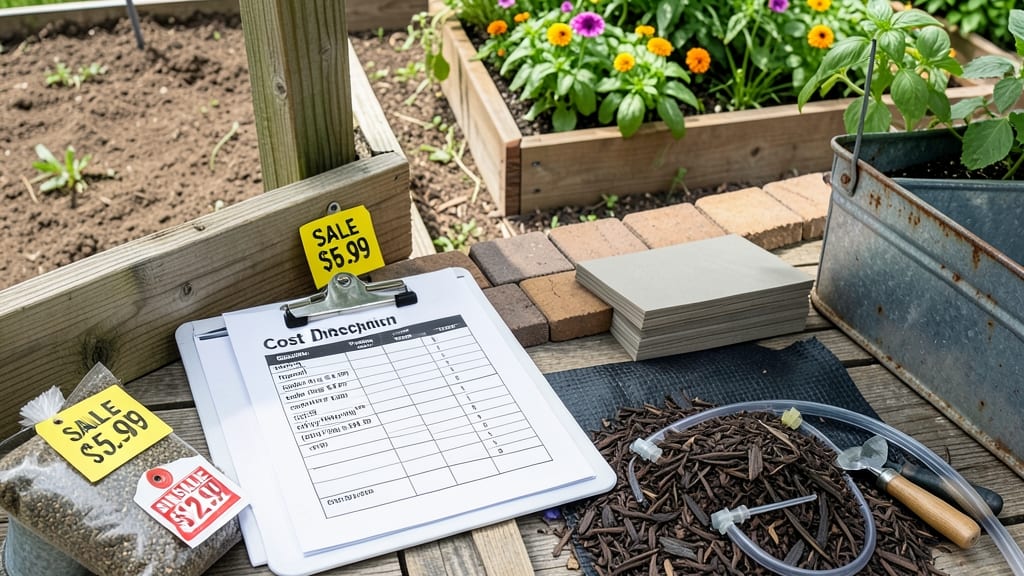
Planning a garden bed costs can feel overwhelming, but prices typically start at $100 for a basic DIY raised bed and climb to $1,500+ for custom in-ground designs. Your total will depend heavily on materials, bed size, and whether you hire help or build yourself.
Understanding garden bed cost starts with material choices—cedar and redwood cost more upfront but resist rot, while composite lumber offers durability without the maintenance. Soil quality also plays a huge role: premium topsoil can add $50-$100 to a project, and raised beds require more fill dirt than in-ground options. 🌱 I’ve found that pre-cut lumber kits (around $200-$400) cut labor time dramatically, while DIY pallet beds can drop costs below $50 if you’re handy with tools.
Don’t overlook the hidden costs either—tools, drainage solutions, and edging materials can add up quickly. For example, a simple cedar raised bed might seem like a $300 project, but when you factor in soil, liner, and hardware, the real cost jumps to $500+.
The good news? Many nurseries offer seasonal discounts on lumber and soil, so timing your purchase can save you 10-20% off total costs.
💡 In This Article
- Key Factors That Influence Garden Bed Pricing
- Budget-Friendly Garden Bed Solutions and DIY Tips
Key factors that influence garden bed pricing
Material selection drives the biggest cost variations in garden beds. Cedar planks cost $3-$7 per board foot due to natural rot resistance, while pressure-treated lumber runs $1.50-$3 per board foot but requires sealing.
Composite lumber, though pricier upfront at $5-$10 per board foot, lasts 20+ years without maintenance—making it cost-effective for high-traffic areas. Stone or brick edging adds $10-$25 per square foot installed, while metal borders like galvanized steel stay under $5 per linear foot but need grounding to prevent rust.
Bed dimensions create a compounding effect on costs. A 4'x8' raised bed requires about 20 linear feet of lumber for framing, while a 2'x6' in-ground bed might use just 12 linear feet of edging.
Soil volume matters too: Raised beds need 1-2 cubic yards of fill dirt (costing $20-$50 per yard), while in-ground beds only require topsoil amendments ($10-$30 per cubic yard). Labor adds another layer—DIY assembly saves $100-$500 compared to professional installation, which charges $20-$50 per hour.
The soil you choose directly impacts both upfront and long-term costs. Premium garden soil blends with compost and mycorrhizal fungi cost $50-$100 per cubic yard, but they improve plant yields by 30-50%—meaning fewer replanting expenses.
Cheaper fill dirt ($10-$20 per yard) may require annual amendments, adding $50-$150 per season in fertilizers. 🌱 For example, a 3'x6' raised bed filled with basic dirt costs $60, but upgrading to enriched soil jumps the price to $180—though your tomatoes might grow 20% larger as a result.
Design complexity introduces hidden costs that often surprise first-time builders. A simple rectangular cedar bed with straight cuts stays under $400, but adding curved edges or tiered levels can increase material waste by 15-25%.
Built-in irrigation systems add $100-$300 depending on whether you use drip tape ($0.50 per foot) or professional-grade emitters ($2 per zone).
Even seemingly small details like corner braces ($3-$8 each) or galvanized screws ($0.20-$0.50 each) multiply quickly when you need 12+ pieces for a large bed.
Location affects pricing through material availability and climate considerations. In urban areas, delivery fees for soil or lumber can add $50-$150 to your total. Coastal regions require rot-resistant materials like cypress or composite lumber, while arid climates may need drip irrigation systems that cost $3-$8 per linear foot installed.
Local building codes sometimes mandate specific materials—like fire-rated cedar in wildfire-prone zones—which can increase costs by 10-20% over standard options.
Consider the long-term value when evaluating costs. A $500 cedar raised bed might last 10-15 years with annual sealing, while a $1,200 stone edged bed could last 30+ years with minimal upkeep.
The annualized cost of the cedar bed becomes $33-$50 per year, compared to just $40-$60 per year for the stone option—making the stone bed the better long-term investment despite the higher upfront cost. 💫