
Advice
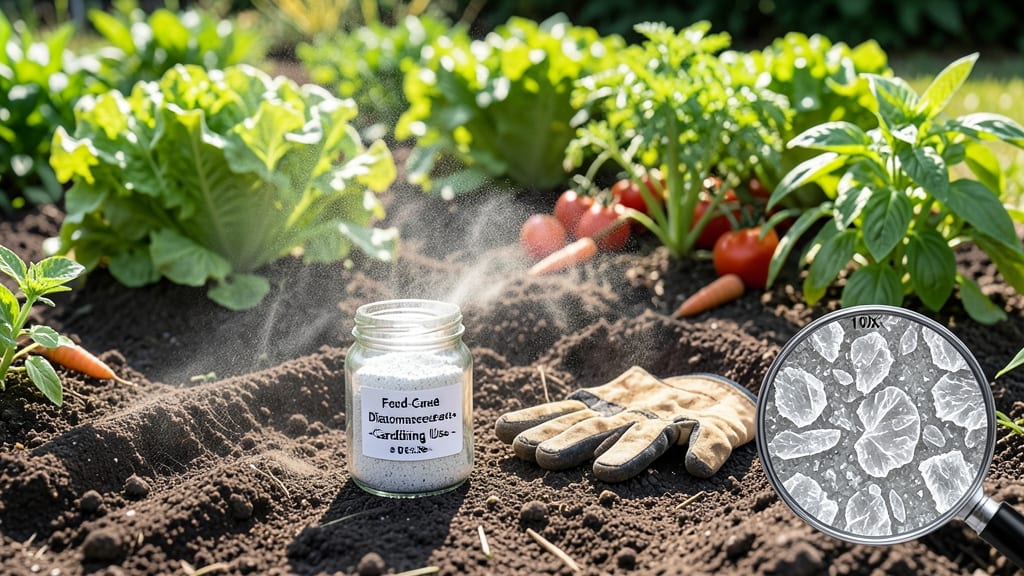
Diatomaceous earth is safe for vegetable gardens when using food-grade varieties, as it breaks down into harmless silica and poses no long-term risk to plants or edible produce. Non-food-grade types contain additives unsafe for consumption and should never be used near crops.
Food-grade diatomaceous earth (DE) is specifically processed to remove impurities, making it ideal for edible gardens. 🌱 The fine powder works by dehydrating pests like slugs and aphids through microscopic silica particles, yet it dissolves harmlessly in soil over time.
I always recommend applying it in dry conditions—early morning or evening—to avoid wind scattering it and reduce inhalation risks. Just remember: never use pool-grade or insecticide-grade DE near vegetables, as these contain toxic additives.
For best results, sprinkle 1-2 tablespoons per square foot around plants, focusing on soil surfaces and under leaves. Reapply after rain or every 2-3 weeks to maintain effectiveness.
The key is consistency: DE doesn't kill pests instantly but disrupts their life cycles over time, making it a gentle yet powerful organic solution for your garden.
💡 In This Article
- How Food-Grade Diatomaceous Earth Protects Gardens Without Harming Plants
- Choosing and Applying Diatomaceous Earth in Vegetable Gardens
How food-grade diatomaceous earth protects gardens without harming plants
Food-grade diatomaceous earth (DE) works as a natural pest control by leveraging its unique composition of amorphous silica—a compound found in plant cell walls and even human bones.
When applied to your garden, the microscopic particles (typically 5-20 microns in size) create a physical barrier that punctures the waxy outer layer of soft-bodied pests like slugs, aphids, and spider mites.
This causes them to lose moisture and dehydrate within 48-72 hours, effectively starving them without introducing chemicals. 🔥 The key difference from non-food-grade DE lies in its 97%+ purity—food-grade versions contain no additives, ensuring it breaks down into harmless silica in the soil.
The safety of DE for edible gardens stems from its biodegradable nature. Unlike synthetic pesticides, DE doesn’t accumulate in soil or water—it simply dissolves over time, releasing silica that plants can absorb.
Studies show that food-grade DE doesn’t harm beneficial soil microbes like earthworms or mycorrhizal fungi, which are crucial for nutrient cycling. For example, a 2018 study in the Journal of Economic Entomology found that food-grade DE reduced cabbage maggot populations by 85% without affecting soil health.
The particle size matters too: finer grades (like 10 microns) are more effective against small pests, while coarser versions work better for larger insects.
What makes DE particularly appealing for organic gardeners is its dual mechanism of action. First, it acts as a physical irritant—pests avoid treated areas due to the abrasive texture. Second, it disrupts insect life cycles by killing eggs and larvae before they mature.
Unlike neurotoxic pesticides, DE doesn’t poison the environment; it simply removes pests through a mechanical process. This is why it’s approved for use in USDA Organic farming when applied correctly. The only caveat?
DE loses effectiveness when wet, so it’s best used in dry conditions to maintain its protective layer.
For vegetable gardens, the non-toxic profile of food-grade DE is its biggest advantage. Since it breaks down into silicon dioxide—the same compound found in sand and quartz—there’s no risk of residue on edible crops.
Even if you harvest vegetables treated with DE, the powder washes off easily with water, leaving no harmful traces. 🌱 However, the application method is critical: using a light dusting (about 1-2 tablespoons per 10 square feet) ensures pests are targeted without smothering plant roots or beneficial insects like bees and ladybugs.
One common misconception is that all DE is the same, but particle size and source matter. Food-grade DE is mined from fossilized diatoms (microscopic algae) and processed to remove impurities like heavy metals.
Non-food-grade versions, often used for pool filtration or insecticides, may contain aluminum silicates or anti-caking agents that are unsafe for edible gardens. Always check for certifications like USP (United States Pharmacopeia) or NF (National Formulary) to ensure purity.
Brands like Safer Brand Diatomaceous Earth or Harris Diatomaceous Earth are popular choices among organic gardeners.
To maximize safety and effectiveness, apply DE early in the morning or late evening when pests are most active and winds are calm. Avoid inhaling the dust—wear a mask and apply it with a duster or sieve for even distribution.
Reapply after rain or every 2-3 weeks to maintain a protective barrier. The beauty of DE is its gentle yet powerful approach: it doesn’t just kill pests on contact but creates an unfavorable environment for them to thrive, making your garden a healthier place for both plants and pollinators. ✨