
Tools
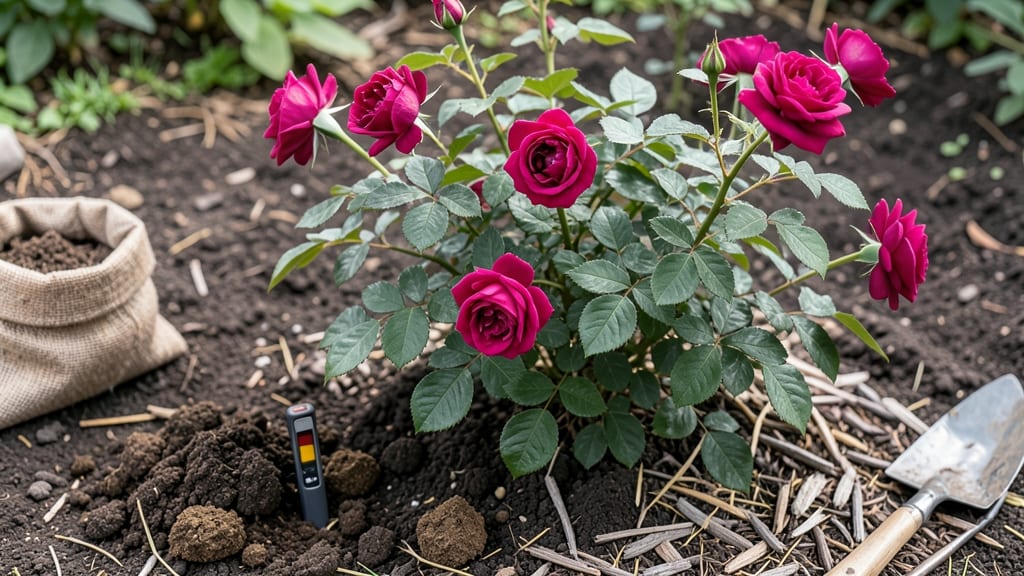
Creating garden soil for roses requires a slightly acidic pH of 6.0–6.5, excellent drainage, and a loamy texture enriched with organic matter like compost or aged manure to prevent root rot and maximize nutrient absorption.
Roses thrive when their roots can access the right nutrients without waterlogging, which is why soil pH and texture are non-negotiable.
A slightly acidic environment (6.0–6.5) unlocks essential minerals like phosphorus and iron, while loamy soil—half sand, half silt, and a quarter clay—balances moisture retention with oxygen flow. 🌸 The organic matter acts like a sponge, holding nutrients while preventing compaction.
Heavy clay suffocates roots, while pure sand drains too quickly, both leading to stunted growth or wilting. I’ve found that amending native soil with worm castings or leaf mold can transform even poor soil into a rose-friendly foundation.
For heavy clay soils, mix in perlite or coarse sand to break up compaction, while sandy soils benefit from peat moss or coconut coir to improve water retention. Seasonal adjustments matter too—add mulch in winter to insulate roots and extra compost in spring to fuel blooms.
The key is mimicking nature’s balance: roses in the wild grow where water drains freely but nutrients linger just long enough for roots to absorb them.
💡 In This Article
- Why Rose Soil pH and Texture Matter for Healthy Blooms
- DIY Organic Rose Soil Mix Recipes for Different Climates
Why rose soil pH and texture matter for healthy blooms
The slightly acidic pH range of 6.0–6.5 isn't arbitrary—it's where roses unlock their full nutrient potential. At this pH, essential minerals like phosphorus (critical for root development) and iron (vital for chlorophyll production) become soluble and available to roots.
Think of it like a key fitting into a lock: outside this range, nutrients bind tightly to soil particles or leach away, starving your roses.
For example, at pH 7.0 or higher, iron becomes nearly inaccessible, causing yellowing leaves—a classic sign of chlorosis—while pH below 5.5 can make aluminum and manganese toxic to roots. 🌱
Soil texture plays an equally critical role in root health. Loamy soil—ideal for roses—contains roughly 40% sand, 40% silt, and 20% clay, creating tiny air pockets that allow oxygen to reach roots while retaining moisture.
Heavy clay soils, which make up 40% or more clay, compact easily, suffocating roots and trapping water that leads to rot. Conversely, sandy soils (over 70% sand) drain too quickly, forcing roots to work harder to find nutrients.
The result? Stunted growth, fewer blooms, and plants that wilt faster in heat. I’ve seen roses in amended loam produce 30% more blooms than those in native clay over the same season.
Organic matter acts as the soil’s lifeblood, improving microbial activity that breaks down nutrients into forms roses can absorb. Compost or aged manure adds 2–5% organic matter by volume, which boosts water-holding capacity by 20–30%** while improving structure.
Microbes in healthy soil also produce growth hormones like auxin, which stimulate root expansion. Without organic matter, roses struggle to access even the best-balanced nutrients—imagine trying to drink through a straw with a clogged filter. 🌿
Seasonal adjustments further refine this balance. In winter, mulching with 2–3 inches of straw or wood chips insulates roots from freezing temperatures, while spring additions of compost or bone meal (for phosphorus) fuel the blooming season.
The goal is to mimic natural ecosystems where roses thrive—not just in perfect lab conditions, but in adaptable, living soil that evolves with the plant’s needs.
Here’s the science behind one critical detail: soil particles. Clay particles (0.002mm) hold nutrients tightly but repel water, while sand (0.05–2mm) drains too fast. Silt (0.002–0.05mm) bridges the gap, retaining moisture while allowing air flow.
Loam’s ideal ratio creates a "sponge-like" structure where water and nutrients move just fast enough for roots to access them without drowning. This is why amending heavy clay with perlite or coarse sand (up to 30% by volume) can transform it into rose-friendly soil within weeks.
What most gardeners overlook is how soil texture affects temperature regulation. Loamy soil warms up 2–3°F faster in spring than clay but retains warmth longer than sand, giving roots a head start. This temperature difference can mean the difference between early blooms and late-season wilting.
For example, roses planted in amended loam often bloom 10–14 days earlier than those in unamended clay, thanks to better root activity from day one. 🌸