
Tools
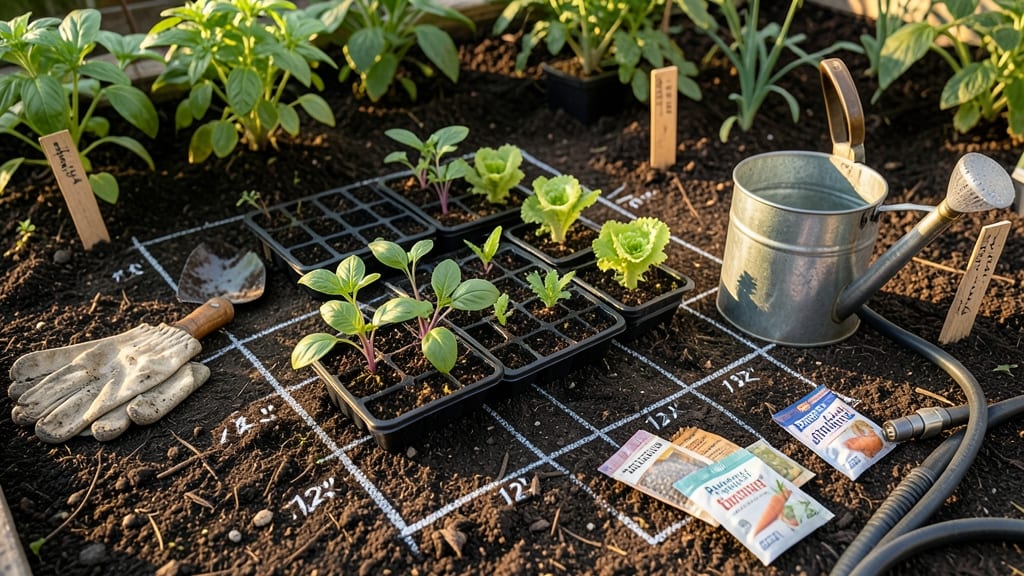
Square foot gardening plans organize your 4x4-foot beds into a 1-foot grid, creating a precision system for planting that eliminates wasted space. This method, developed by Mel Bartholomew, lets you customize plant placement using spacing charts to boost yields while keeping maintenance simple.
This gardening system works by eliminating the guesswork of traditional row planting.
Instead of planting in long rows where plants compete for sunlight and nutrients, the grid system ensures each plant gets exactly the space it needs. 🌱 For example, leafy greens like lettuce can share a square, while larger plants like tomatoes need their own. The result?
A neatly organized bed that produces more food in less space than conventional methods.
What makes this approach so powerful is its flexibility. You can adjust your layout based on what you're growing—whether it's vegetables, herbs, or flowers—and even rotate crops seasonally. The spacing charts act as your blueprint, telling you exactly how many plants of each type fit in a single square.
This isn't just about saving space; it's about growing healthier plants with less effort.
💡 In This Article
- How Square Foot Gardening Maximizes Space Efficiency
- Customizable Square Foot Gardening Layouts by Plant Type
How square foot gardening maximizes space efficiency
The 1-foot grid system works by leveraging plant biology—specifically how roots and canopies compete for resources. In traditional row gardening, outer plants get more sunlight while inner plants struggle for nutrients.
The square foot method eliminates this by giving each plant its own defined space, preventing what scientists call "interspecific competition." For example, a tomato plant needs 1 square foot because its roots spread aggressively, while radishes thrive in 16 per square foot due to their shallow root systems.
This precise spacing ensures no plant is starved for sunlight or water.
The science behind this lies in the "root zone" concept. Each plant's root system occupies a specific volume of soil. By mapping this in a grid, you create micro-environments where roots don't overlap, reducing disease spread and nutrient depletion.
For instance, basil's roots stay compact in 1 square foot, while carrots need 4 inches between plants to prevent root crowding. The method also accounts for plant maturity—young seedlings get crowded initially but spread as they grow, which the grid accommodates through staggered planting.
This system outperforms traditional row gardening in small spaces because it eliminates the "wasted middle" problem. In rows, the center plants often get shaded by taller neighbors, while edge plants may dry out faster. The grid ensures every plant has equal access to sunlight from all directions.
For example, a 4x4-foot bed yields the equivalent of 16 square feet of growing space, compared to just 4 linear feet in a row garden. The vertical space above each plant also matters—taller plants like pole beans get their own squares while shorter ones fill gaps below.
Water efficiency is another key advantage. The grid system allows for zone-specific irrigation. For instance, you can water lettuce (16 per square foot) more frequently than tomatoes (1 per square foot) without overwatering the entire bed.
This targeted approach reduces water waste by up to 30% compared to flood irrigation methods. The compact layout also minimizes soil compaction from foot traffic, as you walk along the paths between beds rather than through planting areas.
The method's success comes from its adaptability to plant growth curves. For example, you might start with 4 onions per square foot in early spring, then replace them with 1 tomato plant as they mature.
This sequential planting keeps the bed productive year-round. The grid also makes crop rotation easier—you can simply shift your planting charts seasonally to prevent soil-borne diseases from building up in the same spots.
Consider how this plays out in real-world scenarios: A traditional 10x10-foot vegetable garden might yield 50 pounds of tomatoes, while a square foot garden of the same area could produce 75 pounds due to optimized spacing.
The difference comes from eliminating the "wasted" center rows where plants often underperform. This isn't just theoretical—gardeners using this method report 2-3x higher yields per square foot compared to conventional planting.