
Vegetables
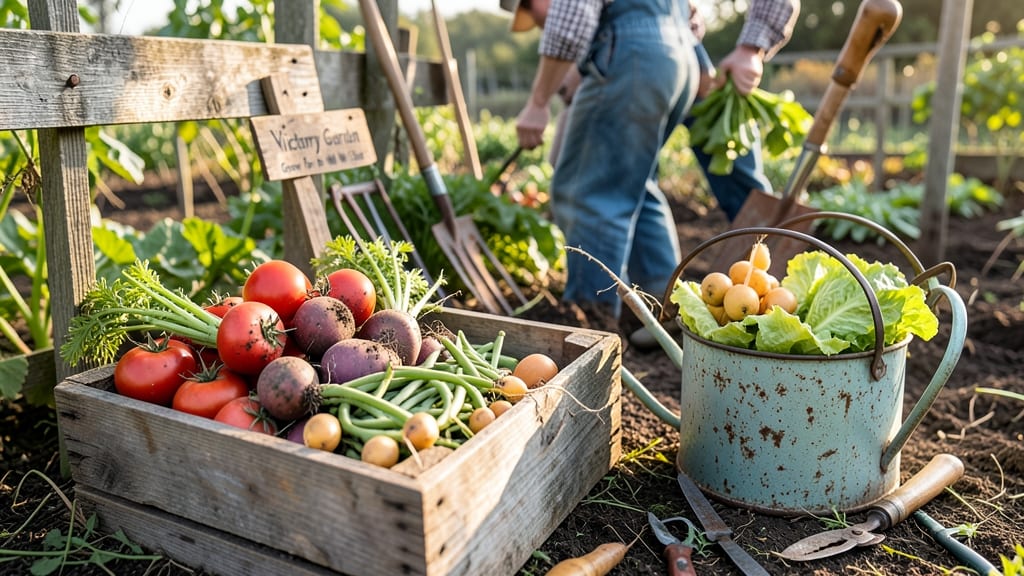
Victory gardens during WW2 produced nearly 40% of America's vegetables, transforming backyards and urban spaces into productive farms that grew high-yield crops like potatoes, tomatoes, and leafy greens to alleviate wartime food shortages.
These gardens weren't just about growing food—they were a patriotic movement that turned civilians into farmers overnight. 💛 The U.S. government promoted them through posters and radio broadcasts, while rationing policies created urgency.
What's fascinating is how ordinary citizens mastered techniques like crop rotation and intensive planting to maximize small spaces, proving that even urban dwellers could contribute significantly to the war effort.
Modern gardeners can still learn from this legacy by focusing on easy-to-grow crops like beans, carrots, and lettuce, which thrive in limited space. The key was selecting fast-growing, nutrient-dense vegetables that provided quick returns, much like today's container gardening trends. Victory gardens remind us that food security starts at home.
💡 In This Article
- How WW2 Victory Gardens Revolutionized Home Food Production
- Top 10 WW2 Victory Garden Crops to Grow Today
How WW2 victory gardens revolutionized home food production
The success of WW2 victory gardens stemmed from a perfect storm of government coordination, scientific agriculture, and public participation. The U.S. Department of Agriculture launched the "War Garden" campaign in 1942, distributing 10 million seed packets by 1943—equivalent to planting 20 million pounds of vegetables.
This wasn't just propaganda; it was a calculated response to rationing that limited meat and dairy, forcing families to rely on vegetables for 30-40% of their dietary calories. 🌱
Crop selection was strategic: gardeners focused on high-yield, nutrient-dense plants like potatoes (which could produce 10-20 pounds per 100 square feet), tomatoes (yielding 20-30 pounds per plant), and leafy greens that grew quickly in small spaces.
Soil management was simplified with techniques like "square-foot gardening" (later popularized by Mel Bartholomew), where plants were spaced precisely to maximize every inch—something modern urban gardeners still use today. The government even provided free soil tests through local extension offices.
Labor efficiency was key—families planted crops that required minimal maintenance but high output. For example, bush beans matured in 50-60 days and could be harvested every 2-3 days, providing continuous yields.
The "Victory Garden Seed Catalog" recommended varieties like 'Early Girl' tomatoes and 'Burpee's Improved' carrots, which were disease-resistant and fast-growing. This practical approach made gardening accessible even to novices, turning backyards into productive farms overnight. 💫
What's often overlooked is how victory gardens addressed food distribution challenges. By growing food locally, they reduced the strain on transportation networks (which were repurposed for military needs) and minimized spoilage from long-distance shipping.
The average victory garden produced 4-5 tons of food annually, enough to feed a family of four for an entire year. This model proved that decentralized food production could be just as effective as large-scale agriculture during crises.
Modern parallels exist in today's urban farming movement. Victory gardens used similar space-saving techniques like vertical growing (trellises for beans and peas) and interplanting (growing radishes between slower carrots). The key lesson?
With the right crop selection and techniques, even small urban plots can produce 25-50% of a family's vegetable needs. The WW2 model shows that food security isn't just about big farms—it's about empowering individuals to grow their own. ✨